
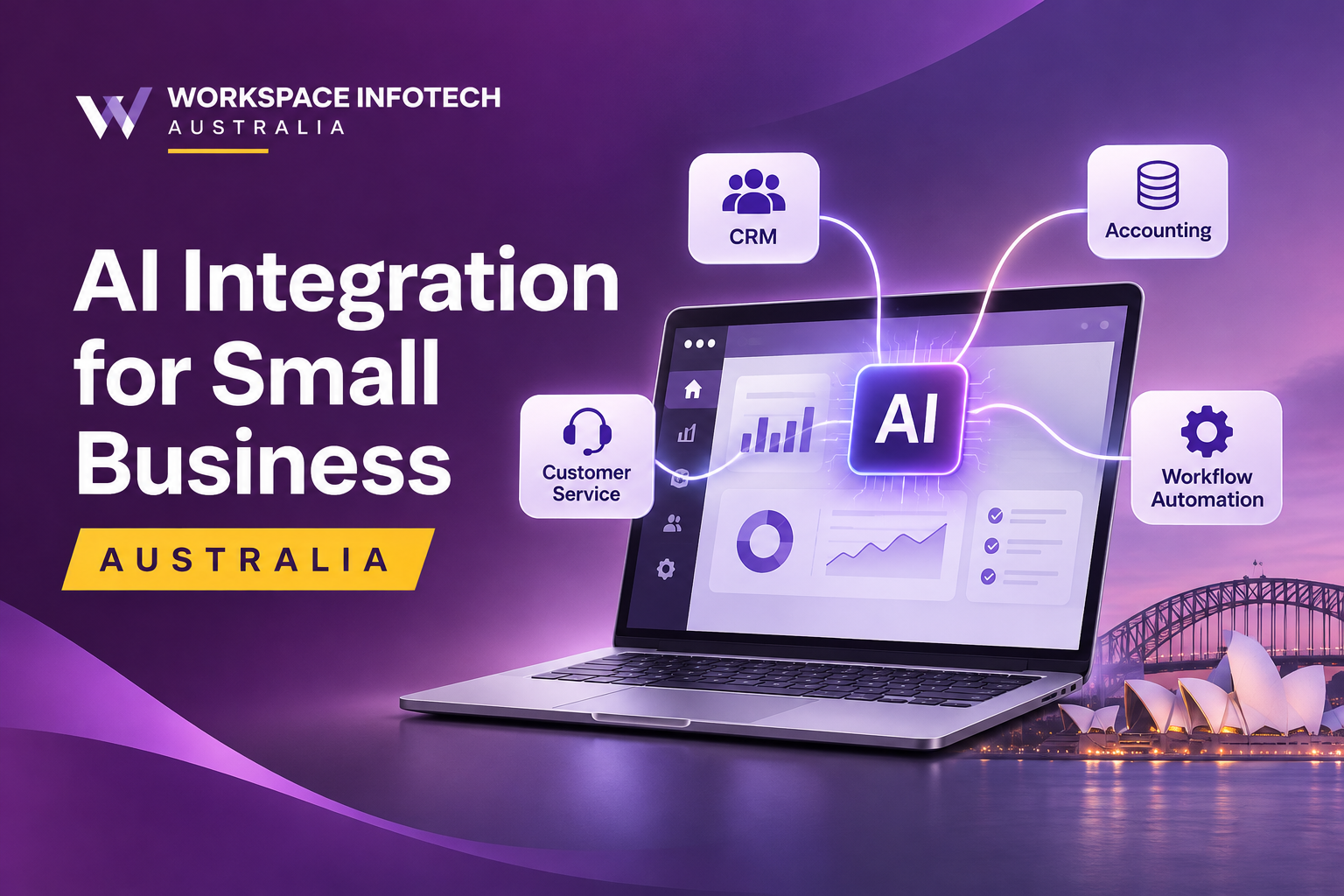

AI is becoming part of everyday business in Australia. But using an AI tool occasionally and integrating AI into your business are two very different things.
You might already use ChatGPT to write emails, generate marketing ideas or summarise documents. These tasks can help, but what happens when your team still copies information between spreadsheets, manually updates customer records and chases invoices?
That’s where AI integration can make a difference. The opportunity isn’t simply to adopt more AI tools. It’s to connect AI with existing systems, simplify repetitive processes and give employees more time for work that needs human judgement.

01 / FOUNDATIONSWhat is AI integration for small business?
AI integration means connecting artificial intelligence capabilities with the applications, data and workflows your business already uses. Instead of opening a separate AI assistant for every task, AI can help within everyday business processes.
Imagine a small Australian service business receiving dozens of website enquiries. Today, employees might read each message, copy contact details into a CRM and manually assign the enquiry. With a carefully designed integration, the process could look like this:
The business retains control of important decisions, while staff spend less time moving information between applications.
02 / AUSTRALIAN MARKETWhy are Australian small businesses exploring AI integration?
Australian SMEs are increasingly interested in AI, but broad adoption does not necessarily mean AI is deeply embedded in operations.
of surveyed Australian SMEs reported some AI adoption in the National AI Centre’s December 2025–February 2026 reporting period. This is not a November-only measurement. Read the National AI Centre report ↗
In August 2026, ABC News reported on Treasury’s concerns that shallow AI adoption could limit potential productivity benefits. The Tech Council of Australia has also outlined the potential economic value of wider SME adoption, although projections are not guaranteed outcomes for individual businesses.
The useful questions are practical: Which customer enquiries take too long? Where are employees copying data between systems? Which recurring tasks can be made more reliable? And can a small pilot demonstrate a measurable benefit?
03 / COMPARISON TABLE ONEAI adoption in Australian small businesses: 2026 vs 2027
This comparison contrasts observed 2026 patterns in AI adoption in Australian small businesses with plausible directions for November 2027. The future column is qualitative, not a measured forecast.
| Key area | November 2026 / current context | November 2027 / expected direction |
|---|---|---|
| AI adoption | 43% of SMEs reported some AI adoption in the Dec 2025–Feb 2026 quarter. | Broader adoption may follow as businesses build skills and confidence. |
| AI usage | Writing, marketing, customer support and reporting are common applications. | More AI may be embedded in CRM, accounting and operational workflows. |
| Business automation | Individual AI tools and basic workflow automation coexist. | Connected, multi-step workflows may become more accessible. |
| Customer service | FAQ assistants and automated reply drafting are familiar entry points. | More context-aware assistance linked to authorised customer records. |
| Integration maturity | Many firms are still testing AI for standalone tasks. | More emphasis may shift towards interoperability and measurable results. |
| Main challenges | Skills gaps, trust, security and uncertainty about business value. | Integration complexity, governance and return on investment may take greater focus. |
Evidence note: the 43% statistic is from an earlier 2026 National AI Centre survey period. All 2027 descriptions are expectations, not confirmed data.
04 / REAL-WORLD APPLICATIONS7 practical AI integration opportunities for Australian SMEs
Choose each AI integration based on business need, data quality and risk—not simply what is trending.

01 AI-powered customer service
A Melbourne service provider could connect an AI assistant to approved website information and its CRM. The assistant could handle common questions, collect enquiry details and route complex requests to staff.
Potential benefit: faster initial responses and fewer repeated administrative steps.
02 CRM and lead management
AI can help categorise incoming enquiries, summarise conversations, draft follow-ups and flag incomplete records. Staff should review significant recommendations before sending messages or changing important information.
Potential benefit: more consistent lead handling and better sales-team visibility.
03 Accounting and invoice processing
AI-enabled applications may extract invoice data, highlight anomalies and support reconciliation or reports. Australian platforms such as Xero and MYOB have announced AI-related functionality, illustrating how these features are moving into familiar software.
Potential benefit: less repetitive finance administration, with professional verification retained.
04 Business process automation
Businesses may use separate applications for orders, inventory, accounting and delivery. Integration can help move information between them, while AI adds value where messages or documents need interpretation. Fixed-rule steps often work better with traditional automation.
Potential benefit: fewer manual handoffs, delays and data-entry errors.
05 Marketing and sales operations
Connected AI can help analyse campaign results, segment enquiries, summarise customer feedback and prepare drafts. Marketing teams still need to verify claims and safeguard customer information.
Potential benefit: more time for strategy and customer relationships.
06 Inventory and demand planning
Retailers and distributors may connect sales history and stock records with forecasting tools to identify changing demand or potential shortages. Recommendations should be tested against actual outcomes.
Potential benefit: earlier operational signals and better-supported stock decisions.
07 Reporting and business insights
AI-assisted reporting can prepare plain-English summaries of authorised business data. A manager might ask which product categories underperformed this month and receive an explanation tied to reliable metrics.
Potential benefit: faster access to usable insights.
05 / COMPARISON TABLE TWOHow business AI applications may evolve by 2027
The table illustrates plausible use-case development—not a prediction that all Australian SMEs will adopt these systems.
| Business function | 2026: common applications | 2027: expected direction |
|---|---|---|
| Marketing | Content drafts, campaign ideas and email copy. | Closer connections to campaign reporting, segmentation and CRM data. |
| Sales & CRM | Lead research, email drafting and manual CRM updates. | AI-assisted qualification, record updates and follow-up recommendations. |
| Customer support | FAQ chatbots and suggested replies. | Assistants linked to customer history with human escalation. |
| Accounting | Invoice extraction, reconciliation assistance and reporting. | More integrated invoice processing and exception detection. |
| Inventory | Spreadsheet analysis and basic demand forecasting. | Forecasting linked more closely to sales and stock systems. |
| Human resources | Job description drafts and CV summaries. | AI support for onboarding and planning, with appropriate oversight. |
| Business decisions | AI-generated reports and summaries. | More timely explanations based on connected, permissioned data. |
The right level of automation depends on the organisation, its systems, the sensitivity of its data and practical return on investment.
06 / BUY OR BUILDAI tools vs custom AI integration: which do you need?
Not every Australian business needs custom AI integration. Standalone assistants can be effective for writing, research and document summaries. Existing CRM or accounting features may already cover standard tasks. Workflow tools may connect applications without a large build.
Consider custom integration where your team needs AI to use business-specific information, follow special permissions, connect legacy systems or support workflows not covered by off-the-shelf products. The objective is to solve a defined problem, not add technology for its own sake. Our article on why Australian SMEs need connected digital systems explains the wider picture.
07 / BUDGETHow much does AI integration cost in Australia?
There is no universal AI integration cost in Australia. Configuration of existing software can be much simpler than a custom solution involving several legacy applications and sensitive information. Compare total cost, not just the initial development quote.
- Software and APIs: subscriptions, model usage and integration limits.
- Complexity: number of systems, workflows and exceptions.
- Data readiness: structure, accuracy and necessary permissions.
- Security: privacy safeguards, access controls and auditability.
- Ongoing support: monitoring, retraining, maintenance and employee education.
08 / IMPLEMENTATION ROADMAPHow to integrate AI into your small business
A structured plan keeps AI integration manageable. Here is how to integrate AI into your small business without disrupting daily work: follow these seven steps in order and keep each one small.
-
Identify one repetitive problem
Document its frequency, people involved, delays and current cost.
-
Audit existing software
Check whether your current platforms have useful built-in features or supported APIs.
-
Assess data and privacy
Define which information is needed, who can access it and which vendors can process it.
-
Choose the simplest reliable approach
Separate routine rules-based automation from tasks that genuinely need AI interpretation.
-
Run a controlled pilot
Test representative tasks and exceptions while retaining human oversight.
-
Measure performance
Track accuracy, customer response times, manual corrections, hours saved and ongoing cost.
-
Improve before expanding
Train staff, monitor outputs and scale only when the benefits are demonstrated.
09 / RESPONSIBLE AIRisks Australian small businesses should manage
Every AI integration carries practical risks that are easier to manage before launch than after.
Privacy: review what personal information a vendor receives, where it is processed and the terms governing its use. Accuracy: AI-generated outputs can be wrong; verify consequential decisions. Cybersecurity: restrict access, monitor integrations and plan for incidents. Overautomation: keep people accountable for financial, employment and other higher-risk decisions. Staff readiness: provide clear training and escalation procedures.
The Australian Cyber Security Centre and Office of the Australian Information Commissioner provide relevant practical guidance.
10 / YOUR TECHNOLOGY PARTNERHow Workspace Infotech Australia can help
Introducing AI into business operations is not simply a matter of choosing a model. It requires understanding your process, reviewing existing systems, selecting a suitable approach and testing the results.
Workspace Infotech Australia provides custom software development, web development, mobile app development, quality assurance and related technology services. Businesses planning AI integration can discuss how existing systems might be connected, modernised or extended to meet specific operational requirements.
Ready to make AI useful for your business?
Start with one bottleneck. We can discuss your existing software, potential integration points and the questions worth answering before investment.
11 / COMMON QUESTIONSFrequently asked questions
What is AI integration for a small business?
It is the process of connecting AI capabilities to existing business software, data and workflows so AI can support tasks inside day-to-day operations.
Is AI integration affordable for Australian SMEs?
It can be. Existing AI-enabled software or small automation projects may provide a practical starting point. Custom integrations need a scoped assessment of development and ongoing costs.
Do we need custom AI software?
Not necessarily. Standard AI assistants and features inside your existing software may already cover the requirement. Custom integration is useful when essential business-specific needs are not supported.
Can AI connect to an existing CRM or ERP?
Often, yes, depending on the platform’s APIs, access permissions, data quality and available technical options.
How long does AI integration take?
It depends on the number of systems, workflow complexity, data readiness, testing requirements and security controls. Define a specific pilot before estimating a timeline.
Is AI safe for Australian businesses?
Responsible adoption requires data protection, vendor checks, limited access, monitoring and human oversight. Assess the sensitivity and consequences of each use case.
Which tasks should we automate first?
Start with frequent, measurable and relatively low-risk tasks such as enquiry categorisation, document preparation, reporting or internal information handling.
What could change by 2027?
More businesses may move from standalone AI tools towards integrations with CRM, accounting and operations. The actual pace depends on costs, skills, security and proven value.
How much does AI integration cost for a small business in Australia?
AI integration cost in Australia varies widely with the number of systems, the quality of your data and the security required. Switching on AI features in software you already pay for is usually the cheapest route. A custom build that connects several systems costs more to scope, build and maintain, so ask for a fixed-scope pilot and compare total cost, including subscriptions, usage fees and support.
What is the difference between AI tools and AI integration?
An AI tool is a standalone assistant that you open to complete a task, such as drafting an email. AI integration connects AI to your CRM, accounting software or other systems, so it can work inside existing processes using approved data and permissions, with staff reviewing important outputs.
Is AI integration worth it for a very small business?
It can be when the task is frequent, measurable and currently manual. A sole trader or a ten-person team may gain more from one well-chosen automation than from a broad rollout. Estimate the hours saved, subtract set-up and running costs, and proceed only if the net benefit is clear.
How does the Privacy Act affect AI integration?
Whether the Privacy Act 1988 applies to your business depends on factors such as annual turnover and the kind of information you handle. If personal information will reach an AI vendor, check where it is stored and how it is used, and read the OAIC’s guidance on commercially available AI products before connecting customer data. Seek legal advice for your situation.
Can we start AI integration without a technical team?
For simple cases, yes. Many CRM, accounting and helpdesk platforms include AI features you can switch on, and workflow tools can link common applications without code. Involve a developer when you need legacy systems connected, custom permissions or audit trails, and define the pilot before you begin.
What should we ask an AI integration partner before we start?
Ask which systems they have connected before, how they handle privacy and access control, how success will be measured and what ongoing support covers. A good partner will propose a small pilot with clear metrics rather than a large upfront build.
Which types of Australian business benefit most from AI integration?
Any business with repetitive enquiry handling, data entry or reporting is a candidate, including service providers, retailers, distributors and professional practices. The best fit is not an industry but a process that is frequent, well documented and measurable, with data you are permitted to use.
Does AI integration replace employees?
It is better understood as removing repetitive handoffs so people can focus on judgement, relationships and exceptions. Keep staff accountable for financial, employment and other higher-risk decisions, and train them to review and correct what the AI produces.
12 / FINAL THOUGHTSStart small. Connect carefully. Measure what matters.
AI integration for small business in Australia is not about replacing employees or adopting technology simply because it is new. It is about making operations more connected, efficient and manageable.
As businesses look towards 2027, the next opportunity is to move beyond experimenting with AI and begin applying AI integration to workflows that matter. Whether the task involves customer service, CRM updates, accounting or reporting, the starting point should be a real problem.
Start with one useful integration. Measure its value. Improve it. Then decide what to automate next.
Sources and further reading
- Australian Government — Artificial Intelligence
- National AI Centre — AI Adoption Insights, Dec 2025–Feb 2026
- ABC News — Australia and the AI productivity opportunity, 31 August 2026
- Tech Council of Australia — AI x SME research, October 2026
- Australian Cyber Security Centre — Artificial Intelligence for Small Business
- OAIC — Guidance on Privacy and Commercially Available AI Products
Editorial note: 2027 comparison columns describe potential trends, not observed future results. Publication facts and external page links should be checked again before the article goes live.