
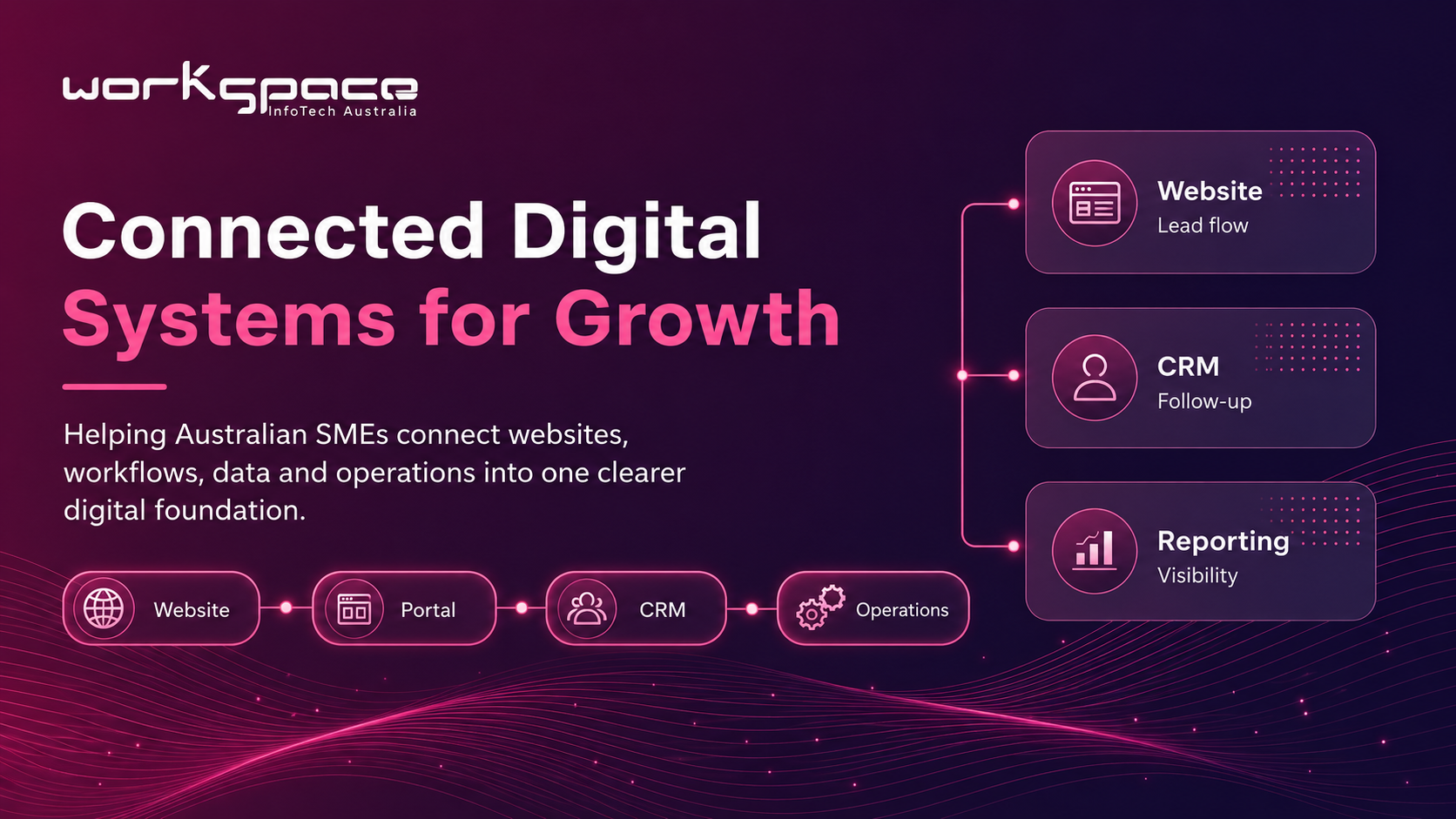
The digital problem many SMEs quietly carry
Many Australian SMEs have worked hard to become more digital. They have websites, social channels, accounting platforms, cloud folders, email systems, project tools and sometimes a CRM. On paper, that looks like progress.
But inside the business, the daily experience can still feel disconnected. A website enquiry might be copied manually into a spreadsheet. A customer update might sit in someone’s inbox. Finance may have one version of the information while operations has another. Managers may wait for someone to prepare a report before they can see what is happening.
The problem is not always the absence of software. The problem is that the software is not working together.
What the Australian market data suggests
The latest Australian business data points to a practical reality: digital activity is now normal, but digital maturity is still uneven. The Australian Bureau of Statistics reported that 32% of businesses received orders online in 2024-25, 34% said ICT improved responsiveness to customer needs, 12% used AI and 21% experienced a cyber security incident. At the same time, only 10% actively collected or analysed data for decision-making.
Victoria also has a strong digital economy around WSIT AU’s home market. Victorian Government data reported more than A$142 billion in Victorian digital technology business revenue in FY24 and over 306,000 people in Victoria’s technology workforce in 2024.
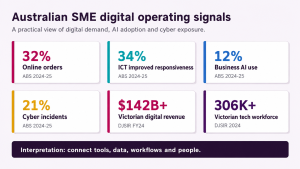
Figure 1. Australian SME digital operating signals from ABS and Victorian Government data.
More software is not the same as better operations
A business can buy another subscription and still have the same operational problem. If data is copied by hand, if customer communication is scattered, if approvals depend on long email chains and if reports are prepared manually, adding one more tool may simply add one more place to check.
Connected digital systems take a different approach. They ask how the work actually moves through the business. Where does a lead become a customer. Where does the customer become a project. Where do invoices, service updates, files, approvals and reports fit into the same journey. Once that journey is understood, technology can be designed around it.
This is where custom software, web platforms, mobile applications, integrations, QA and hosting begin to work as one delivery conversation instead of separate technical services.
Where connected systems create value
| Business friction | Connected system response | Practical value |
| Website enquiries are copied manually | Connect forms to CRM or internal workflow | Faster follow-up and fewer missed requests |
| Project updates live in email or chat | Create a dashboard or customer portal | Better visibility for staff and customers |
| Finance and operations use separate data | Integrate invoices, payments and reporting | Clearer business view for leaders |
| Teams repeat the same admin tasks | Automate routine notifications and status updates | More capacity for meaningful work |
| Launch quality feels uncertain | Add structured QA before release | Fewer defects and stronger confidence |
| Systems are online but unsupported | Plan hosting, monitoring and backups | More reliable digital operations |
A practical roadmap for Australian SMEs
The best digital improvement is usually not the biggest one. It is the one that removes the most friction from a real workflow. A simple five-step roadmap can help SMEs start without overcomplicating the technology stack.
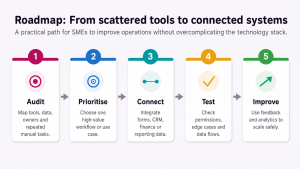
Figure 2. A practical path from scattered tools to connected systems.
Where Workspace InfoTech Australia fits
Workspace InfoTech Australia PTY Limited positions itself as an Australia-Bangladesh joint venture software company that supports online business needs through software development, web development, mobile app development, graphic design, quality assurance and hosting services. Its Clutch profile also lists the company in South Yarra and identifies service lines such as custom software development, graphic design, web development and mobile app development.
That service mix matters because connected systems are not just a design task or only a coding task. They require discovery, process thinking, user experience, development, integration, quality assurance, hosting and support. For SMEs, having those capabilities connected under one practical delivery approach can make digital improvement easier to plan and easier to maintain after launch.
The strongest digital partners do not simply ask, ‘What feature do you want?’ They ask, ‘What part of your business should work better?’ That question leads to better software, better adoption and better long-term value.
Final thoughts
Australian SMEs do not need to digitise everything at once. They need to identify where daily work is still being copied, chased, repeated or manually reconnected. That is usually where the next valuable digital improvement begins.
The future belongs not only to businesses that use more technology, but to businesses that connect technology in a way that makes work clearer, faster and more reliable.
More software is not always the answer. Better-connected systems usually are.
| Ready to build a more connected digital foundation? Talk to Workspace InfoTech Australia about custom software, web platforms, mobile apps, QA, hosting and digital support. Visit https://workspaceit.com.au/ |
SEO & Publishing Details
| Field | Recommended copy |
| SEO Title | Connected Digital Systems for Australian SMEs | WSIT AU |
| Focus keyword | connected digital systems Australia |
| Meta description | Learn why Australian SMEs need connected digital systems that link websites, workflows, data and operations for better visibility, efficiency and growth. |
| URL slug | connected-digital-systems-australian-smes |
| Category | Digital Transformation |
| Tags | connected systems, custom software, Australian SME, web development, digital transformation, QA, hosting, Workspace InfoTech Australia |
| Suggested CTA link | https://workspaceit.com.au/contact |