
Making the Right Choice for Long-Term Digital Success
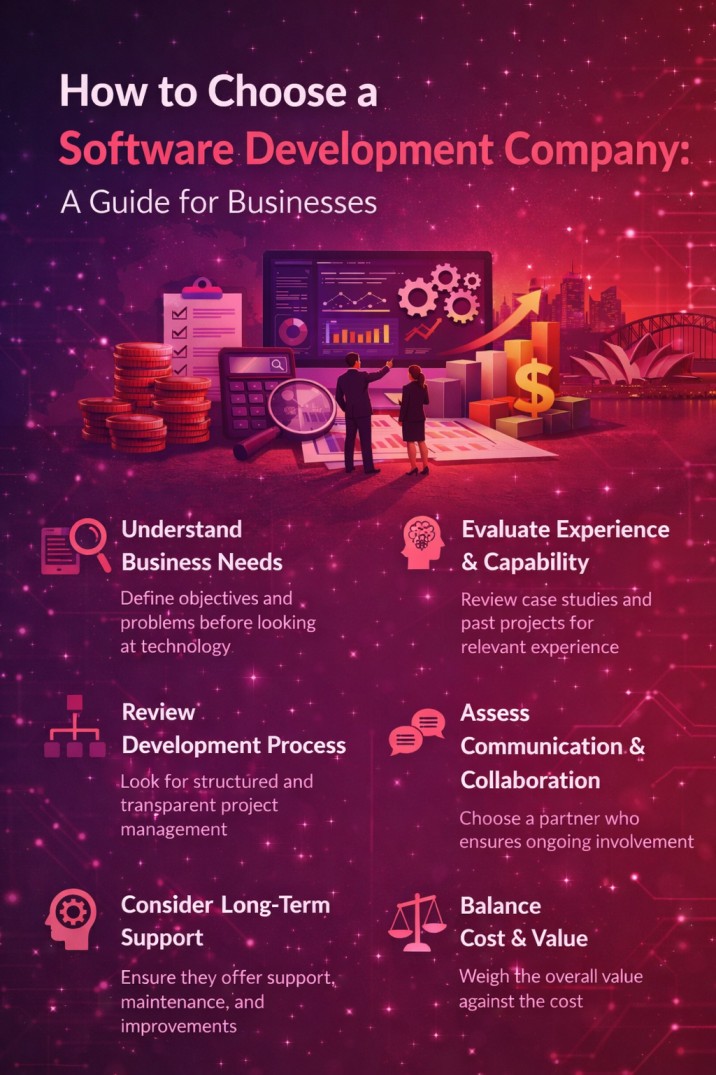
A visual guide to selecting the right software development company for your business needs.
Understanding how to choose a software development company is essential for businesses planning to build scalable digital solutions. Choosing a software development company is an important decision for any organisation planning to invest in digital solutions. Whether the goal is to build a custom platform, automate internal workflows, or develop a customer-facing application, the development partner a business selects can significantly influence the success of the project.
How to Choose a Software Development Company
Today, thousands of companies offer software development services, each claiming technical expertise and innovation. However, successful projects rarely depend on technical ability alone. The most effective development partners combine strong technical skills with a deep understanding of business processes, structured development methods, and clear communication throughout the project lifecycle.
For businesses, understanding what to evaluate when selecting a development partner can reduce risks, improve collaboration, and ensure that the final system delivers long-term operational value.
Understanding Business Needs Before Technology
One of the most common mistakes organisations make when selecting a software development company is focusing too quickly on technology rather than business objectives. Software should always be built to solve a specific operational challenge or support a strategic goal.
Before evaluating development companies, businesses should clearly define what they want to achieve. This includes identifying the problem the software will address, understanding the users who will interact with the system, and determining how the solution will integrate with existing processes.
Development companies that begin by exploring business context rather than jumping directly into technical discussions often produce more effective solutions. By understanding workflows, team responsibilities, and operational pain points, they are able to design systems that genuinely improve efficiency instead of simply introducing new digital tools.
Evaluating Experience and Project Capability
Experience is another critical factor when choosing a development partner. Companies that have previously worked on complex software systems are more likely to anticipate potential challenges and manage them effectively.
Businesses should look for development partners with experience in building scalable platforms, integrating multiple systems, and supporting growing organisations. Reviewing case studies, past projects, and technical portfolios can provide valuable insight into how a development company approaches real-world problems.
The goal is not simply to find a team capable of writing code. Instead, businesses should look for a partner that understands how technology interacts with operations, users, and long-term business strategy.
Reviewing the Development Process
Reliable software development companies follow a structured development process. This process ensures that projects remain organised, transparent, and aligned with business expectations.
Typically, a well-managed project begins with requirement analysis and system planning. During this stage, development teams work closely with stakeholders to define features, workflows, and system architecture. Once planning is complete, development proceeds in stages, allowing businesses to review progress and provide feedback throughout the process.
Testing and quality assurance also play a major role in successful software delivery. Before deployment, the system must be evaluated to ensure that it performs reliably under real-world conditions. When companies follow a structured development approach, projects are more predictable and easier to manage.
Communication and Collaboration
Custom software development is rarely a one-time interaction between a business and a development team. Instead, it is a collaborative process that requires ongoing discussion, decision-making, and refinement.
For this reason, communication should be a key consideration when choosing a development partner. A reliable software development company maintains transparency about project timelines, explains technical concepts clearly, and provides regular updates about progress.
When communication is consistent and collaborative, businesses remain involved in the development process and can guide the project as new insights emerge. This collaboration helps ensure that the final product aligns with operational needs and user expectations. Many businesses also rely on platforms like AWS.
Considering Long-Term Support
Launching a software system is only the beginning of its lifecycle. As businesses grow, their digital systems must evolve as well. Updates, new integrations, performance improvements, and security enhancements are often necessary over time.
For this reason, organisations should evaluate whether a software development company offers long-term support and maintenance services. A dependable development partner remains involved after deployment, helping businesses improve and expand their systems as operational requirements change.
This ongoing relationship ensures that software continues to deliver value rather than becoming outdated or difficult to maintain.
Balancing Cost and Long-Term Value
Budget considerations naturally play a role in selecting a development partner. However, focusing exclusively on price can lead to decisions that create challenges later in the project.
Low-cost development often involves shortcuts in planning, testing, or documentation. These compromises can result in unreliable systems that require expensive revisions after launch.
Instead of comparing companies solely based on pricing, businesses should consider overall value. Factors such as experience, development methodology, communication practices, and long-term support often determine whether a project succeeds or struggles.
Investing in a capable development partner frequently leads to better performance, greater efficiency, and stronger long-term outcomes.
Choosing the right software development company ultimately comes down to finding a partner that understands both technology and business strategy. When organisations take time to evaluate experience, communication, development processes, and long-term support capabilities, they are far more likely to build systems that support growth and operational efficiency.
The right development partner does more than deliver software. They help businesses create digital systems that improve workflows, support decision-making, and adapt as the organisation evolves.
Written by: Workspace InfoTech Team
Role: Custom Software Development Partner for Australian Businesses